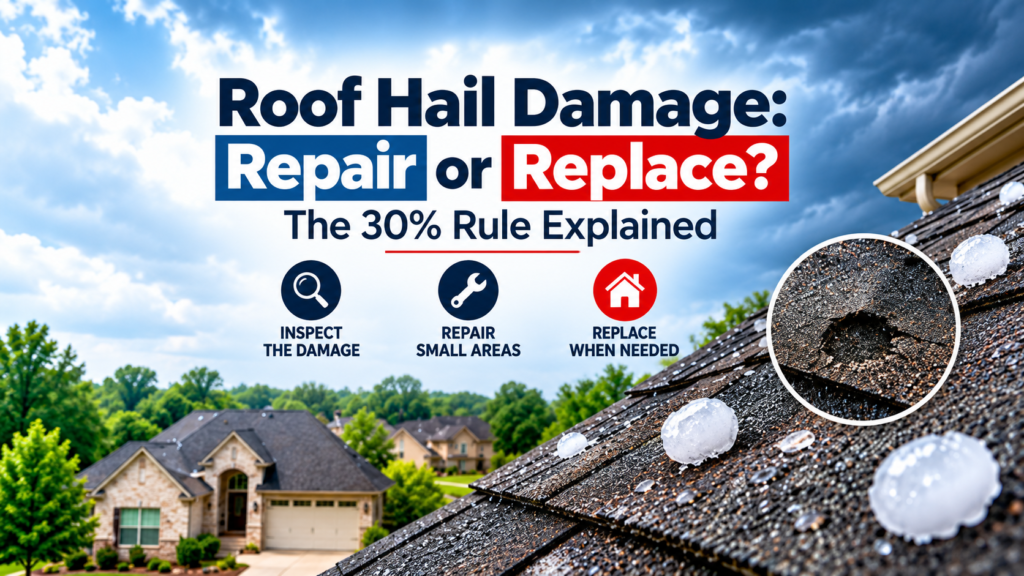
Did that storm actually hurt your roof, or did it just rattle your nerves? Repair roof hail damage if it affects a small area and the nearby shingles remain sound. Widespread damage may call for replacement. The 30% rule is a rough guide some roofers use, not a fixed rule in Texas code or insurance policies.
Texas recorded 902 major hail events in 2025, the highest state total, according to the Insurance Information Institute. Yet your roof can look fine from the driveway while damage sits beneath the surface. If you feel unsure after a storm, a roof check can help you see what needs work.
How Hail Damages Roof Shingles
Hail can bruise a shingle without leaving a hole. A strong strike can break its fiberglass mat, which gives the shingle strength. That fractured mat may still shed rain at first, so a dry ceiling does not rule out damage.
The same strike can knock off shingle granules that shield the asphalt from sunlight. Over time, exposed areas can wear faster. However, granule loss alone does not prove hail caused it.
If wind lifts tabs during the storm, it can also break the self-seal strip that holds them down. Your roofer should check both wind and hail effects before choosing a repair. GAF’s storm repair guidance explains why the type of damage matters.
The 30% Rule: When to Repair or Replace
The idea behind the 30% rule is simple: as damage spreads, repeated spot repairs may offer less value. However, no single percentage tells you whether a roof slope needs replacement.
If damage affects less than 30%, brittle shingles may still make repairs difficult. Even so, damage above that figure does not always mean you need a full roof replacement. Your roofer needs to check each slope. They must also see if nearby shingles can handle repair work.
How Roofers Inspect Hail Damage on Roof Slopes
To assess roof damage from hail, an inspector checks each slope and records the signs of damage.
- Test areas: Inspectors may mark 10 ft x 10 ft test squares and count confirmed hits per test square. There is no universal 8-hit approval threshold.
- Impact pattern: A random impact pattern can support hail findings. However, the inspector must also rule out blistering, foot traffic, and other causes.
- Slope exposure: Wind can drive hail harder against 1 side, so each roof slope needs its own review.
- Roof details: Ridge caps, valleys, roof vents, and flashing need checks alongside the field shingles that cover most of your roof.
At Solutions Contracting, we explain these findings during your free roof inspection. Photos help you see the damage, while drone imagery can support the wider view where available. Close inspection still matters because aerial photos may miss a hail bruise.
The 25% Rule for Roofing and Texas Building Code
The 25% rule for roofing commonly refers to Florida provisions, including exceptions for roofs that meet certain code editions. You should not apply it as a statewide Texas rule. Florida’s roofing statute explains that distinction.
For a DFW home, the local building code sets the rules for repairs and an overlay. Your roof work may need drip edge, ice and water shield, or underlayment upgrades where required. However, crossing 25% does not mean every Texas roof needs those items.
Functional Damage vs Cosmetic Damage
Functional damage harms how a roof works or how long it should last. Cosmetic damage changes how it looks while it still works as it should. If your policy includes a cosmetic exclusion, that difference can affect coverage.
| Inspection finding | Possible classification | What it means for you |
| Fractured mat or confirmed bruised shingles | Functional damage | The shingle may need replacement even without a leak. |
| Exposed bitumen or mat exposure | Needs closer review | Your roofer needs to check the cause and depth. |
| Dented gutters, vents, or pipe boots | Cosmetic or functional | A dent may not stop the part from working. |
| Surface scuffs with an intact mat | Often cosmetic | Normal wear and tear can leave similar marks. |
| Metal dents without leaks or seam damage | Often cosmetic | Your policy wording still matters. |
A roofer may use gentle thumb pressure to help assess a soft spot. However, that alone cannot confirm hail damage. The mark, surrounding shingles, and storm evidence must support the finding.
Hail Size and Roof Damage Risk
Hail size helps explain storm severity, but size alone does not tell you how much damage occurred. Quarter size hail deserves attention, though smaller stones can affect a worn roof. Larger hail can cause much more serious impact damage.
| Hail size | Common comparison | Possible roof effects |
| 0.25 inch | Pea size hail | Usually limited effects on sound shingles. |
| 0.5 to 0.75 inch | Marble to dime | Older shingles may lose granules or suffer bruising. |
| 1 inch | Quarter size hail | Bruising and mat damage become a concern. |
| 1.25 inches | Half dollar | Stronger impacts can increase cracking risk. |
| 1.5 inches | Ping-pong ball | Impacts may cause splits and tears. |
| 1.75 inches | Golf ball size hail | Serious shingle damage and flashing dents can occur. |
| About 2.5 to 4.5 inches | Tennis ball to softball | Severe impacts may cause punctures or decking damage. |
These sizes give you a rough guide. They do not prove how much damage your roof has. The National Weather Service hail guide lists common size references.
Hail density, wind speed, impact angle, and roof pitch also affect the result. That is why your neighbor’s roof may escape hail storm roof damage while yours needs work. We assess the damage on your home before recommending a tear-off.
Roof Repair vs Replacement: What Matters Most
If you face a hail damage roof repair decision, look beyond the number of marks. Roof age matters, but so does the state of the shingles. If they break when a roofer lifts them, a small repair may spread.
| Factor | Repair may suit the roof | Replacement may make more sense |
| Damage spread | A small, isolated area | Widespread damage across a slope or several slopes |
| Roof age and condition | Sound, flexible shingles | Worn or brittle shingles that break during repairs |
| Shingle availability | Compatible shingles and a reasonable color match | Discontinued shingles or poor repair compatibility |
| Code requirements | A repair can meet local rules | The required scope makes replacement more practical |
| Cost and coverage | Repairs offer good value | The repair cost approaches replacement cost |
A roof under 10 years old may still need major work after severe hail. Likewise, a roof past 15 years needs an inspection before anyone rules out repairs.
For example, a 17-year-old roof with damage across 3 slopes needs a close look at both costs. An RCV policy may help with covered work, but your deductible and policy terms still apply.
Solutions Contracting provides roof repairs and roof replacement. If your project needs reinforced decking or better ventilation, we explain why and include it in the scope. If repairs make sense, we tell you that too.
Hail Damage by Roofing Material
The link between hail and roof damage depends on the material. Your roofer should know which signs to look for on each roof type.
- Asphalt shingles: Bruises, cracks, and mat damage help determine whether hail damage roof replacement makes sense.
- Metal roofing: Dents on standing seam metal roofing may affect appearance only. However, damaged seams or punctures need closer attention.
- Clay and concrete tile: Hail can crack or chip tiles, but curved corner cracks alone do not prove the cause.
- Wood shakes: Fresh wood shake splits along the grain need comparison with age checking and other weathered cracks.
- Flat and low-slope commercial roofs: Membrane punctures can allow water inside even when the roof looks fine from below.
Impact-Resistant Roofing Options
If you plan to replace the roof, consider impact-resistant shingles. Class 4 under UL 2218 means the shingle passed a lab impact test. It does not mean hail can never damage it.
The Insurance Institute for Business and Home Safety also tests shingles in ways that mimic real hail. Its ratings help you see how each shingle held up.
Solutions Contracting installs designer and stone coated steel roofing. We can discuss how each option suits your home, budget, and storm exposure.
Insurance Hail Damage Roof Claims in Texas
If a covered storm damages your roof, the policy sets the payment terms. Replacement cost coverage generally pays the covered repair or replacement cost, less your deductible. Actual cash value pays the depreciated amount, also less the deductible.
The Texas Department of Insurance explains that replacement cost claims commonly involve two checks. Your insurer pays part first. It sends the rest of the covered amount once you meet its rules for the repairs. Normal wear alone does not qualify for a new roof.
What to Check Before Filing
- Deductible: Check whether your wind and hail deductible uses a fixed sum or a percentage of dwelling coverage.
- Roof coverage: A roof surface schedule endorsement may limit payment by roof age or material. Check what it pays before you plan the work.
- Storm date: Use Storm Prediction Center reports to support the date of loss, alongside your own records. Those reports cannot prove damage at your address.
- Photos: Keep timestamped photos of roof clues, AC condenser fins, and torn window screens, taken from safe ground.
- Repair scope: Compare the scope of loss with the roofer’s findings, including step flashing, drip edge, and pipe boots.
We record what we find and can meet your adjuster on site. Since adjuster standards vary, clear photos and measurements help explain the work. Your insurer decides coverage. If storm chasers pressure you to sign quickly, take time to review the contractor and written scope.
Signs of a Hail Damaged Roof From the Ground
Please stay off the roof, especially if hidden soft decking could give way. Your yard offers useful clues, though it cannot reveal every problem above.
- Granules near your downspouts can suggest shingle wear. If they appeared after hail, arrange a closer inspection.
- Dents in gutters, downspouts, and metal fascia support evidence of impacts, but cannot confirm shingle damage alone.
- Marks on your AC unit, mailbox, garage door, or furniture can help document the storm’s reach.
- Cracked vinyl siding, damaged window trim, and torn screens deserve photos alongside roof findings.
- Water stains, blistered paint, or damp ceilings need prompt attention because water may have entered your home.
Our crews serve Fort Worth, Arlington, and Weatherford. If rain can enter an exposed area, contact our emergency storm response team about tarping. For same-day help, we need safe weather and a crew free to reach you.
Schedule a Roof Hail Damage Inspection in DFW
A roof damaged by hail needs a clear plan before more rain arrives. A prompt roof check helps you plan repairs while signs of the storm are still clear.
Solutions Contracting brings over 10 years of roofing experience and a Better Business Bureau A+ rating. If you need roofing contractors in Fort Worth, call 682-469-9519 or contact the Solutions Contracting office. We will explain what we find so you can choose the next step with confidence.
Frequently Asked Questions
1. Can Hail Damage Be Repaired, or Is Full Replacement Necessary?
Repairs can work if damage stays local and the surrounding shingles remain sound. If repairs would break nearby shingles, replacement may offer better value. An inspection should support either choice.
2. What Is the 25% Rule for Roofing?
It commonly refers to Florida roofing provisions with exceptions. For a Texas home, use the local code and project requirements rather than assuming a statewide 25% trigger.
3. Will My Premium Go Up if I Claim for Hail Roof Damage Insurance?
Texas insurers cannot surcharge you for weather-related claims, according to TDI’s premium guidance. However, rate changes across your area can still raise premiums. Zip code loss ratios do not create an automatic higher risk tier after 2 hail claims.
4. How Long Do I Have to File for Hail Damage to My Roof in Texas?
Report damage promptly. Some policies set a 1-year deadline, but terms vary. Read the duties after loss section and endorsements; your declarations page alone may not show the deadline. TDI’s home insurance guide explains reporting requirements.
5. Does Hail Damage Roofs Even When There Is No Leak?
Yes. Hail can damage the mat while shingles still shed rain. If you suspect storm damage, arrange an inspection rather than waiting for a ceiling stain.