
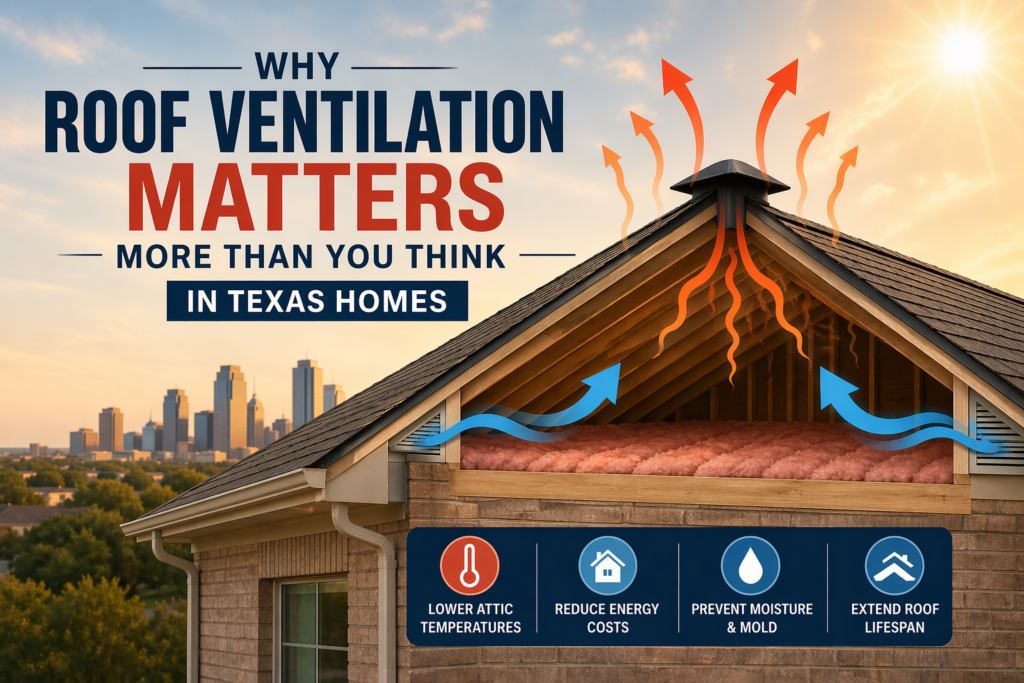
Ever wondered why your upstairs bedroom feels like a sauna by 3 PM every summer? The answer hides right above your ceiling. Across North Texas, attic temperatures climb past 150°F on a regular 100°F day, and that trapped heat pushes straight down into your living space.
According to ENERGY STAR, natural airflow in a well-vented attic moves super-heated air out, protecting your roof shingles and removing moisture. Without proper roof ventilation, your shingles bake from underneath, your insulation loses its R-value, and your AC never catches a break.
This one roofing detail decides whether your home stays cool, dry, and protected, or slowly cooks itself from the inside. Our team at Solutions Contracting sees this every week across DFW homes.
What Roof Ventilation Actually Does for Your Texas Home
Roof ventilation is the balanced system of intake vents and exhaust vents that keeps outside air moving through your attic space. It runs on the stack effect, a simple rule of natural convection. Hot air rises and escapes at the peak while cooler, drier air enters low along the eaves.
A well-designed system delivers three wins every Texas homeowner can feel:
- Temperature regulation that keeps the attic within 15°F of outdoor air.
- Moisture control that stops condensation, wood rot, and mold growth cold.
- Extended roof lifespan that protects your shingles for 5 to 7 extra years.
The Hidden Cost of Poor Attic Ventilation in Texas Summers
When attic ventilation fails, damage starts quietly and spreads fast. Trapped heat buildup cooks the oils out of asphalt shingles, causing blistering, curling, and premature shingle aging. Moisture buildup during humid spells soaks your attic insulation and rots the roof decking from below.
Watch for these red flags inside your home:
- Hot upstairs rooms even when the AC runs for hours.
- Musty odors or visible mildew near the rafters.
- Curled or cracked shingles visible from the ground.
- Energy bills that spike from May through September.
- Ice dams during rare North Texas cold snaps.
Signs You Need Roof Vent Installation Right Now
A quick attic inspection tells the whole story. If your attic feels 40°F hotter than outside, your current setup is failing. Roof vent installation becomes urgent when you spot damp insulation, rusty nail heads, or dark streaks across the underside of the deck.
Our crew checks for the following during every free evaluation:
- Blocked soffit vents painted shut during past exterior work.
- Missing or undersized ridge vents at the roof peak.
- Old turbine vents that no longer spin freely.
- Imbalanced intake and exhaust ratios.
- Attic bypasses around chimneys, ducts, and can lights.
The Balanced Ventilation System Every Texas Roof Deserves
Texas building code follows the 1:150 net free area rule. That means one square foot of free ventilation area for every 150 square feet of attic floor. A balanced ventilation system splits that airflow 50/50 between intake and exhaust.
Intake Vents That Pull Cool Air In
Soffit vents along the eaves draw fresh outside air into the attic. Continuous strip soffits deliver the most consistent airflow for DFW homes.
Exhaust Vents That Push Hot Air Out
Ridge vents along the roof peak are the gold standard for passive roof ventilation. When your home cannot support a full ridgeline, we install box vents, gable vents, or a solar attic fan instead.
Types of Roof Vents We Install Across DFW
| Vent Type | Power Source | Best For |
| Ridge vent | Passive convection | Long, straight rooflines |
| Soffit vent | Passive intake | Every Texas home |
| Solar attic fan | Sunlight | Homes with short ridges |
| Powered attic ventilator | Electric | Extreme heat attics |
| Turbine vent | Wind | Breezy suburban lots |
How Proper Ventilation Saves You Money Every Month
A balanced attic ventilation setup delivers returns you feel on the first utility bill. Industry research shows proper ventilation can extend roof life by up to 20%. Homeowners across Fort Worth, Arlington, and North Richland Hills report 10% to 15% lower cooling costs after a professional roof vent installation.
Here is where the savings add up:
- Lower HVAC strain thanks to cooler attic temperatures.
- Protected insulation that keeps its full R-value year-round.
- Fewer roof repairs from thermal stress and moisture damage.
- Longer shingle warranty protection from major manufacturers.
- Better indoor air quality and fewer allergens pulled from the attic.
Ready to Give Your Attic Room to Breathe?
Your roof does far more than keep rain out. It fights Texas heat, humidity, and storms every single day. When roof ventilation falls behind, every part of your home pays the price, from your shingles to your electric bill.
Our team at Solutions Contracting handles new vent installs, attic ventilation upgrades, and full roof inspections across Dallas, Fort Worth, Arlington, and the wider DFW metro. We are GAF-certified, fully insured, and focused on balanced systems built for Texas weather. Call Solutions Contracting today for your free attic inspection, and let us show you how much cooler, drier, and quieter your home can feel.
Frequently Asked Questions About Roof Ventilation in Texas
How much does roof vent installation cost in DFW?
Most DFW homes pay between $400 and $1,200 depending on vent type and roof size. Solar attic fans run higher because of the panel and motor. We always provide a written free estimate before any work starts.
Can I add ridge vents without replacing the whole roof?
Yes, ridge vents install in existing roofs with minimal disruption. The job usually wraps up in one working day on a standard single-story home. We seal every cut to keep wind-driven rain out.
How often should I inspect my attic ventilation?
Once a year is the minimum, and always after a major hail or windstorm. Blocked soffits and damaged turbines are the most common issues we spot. A quick inspection saves thousands in future repairs.
Are solar attic fans worth it in North Texas?
Absolutely, especially on homes with short ridgelines. They run free all summer and drop attic temperatures by 20°F to 30°F. No wiring means zero extra load on your electric bill.
Does attic ventilation help in winter too?
Yes, it moves warm moist air out before it condenses on cold surfaces. This prevents hidden mold, wet insulation, and rare North Texas ice dams. Year-round airflow protects your home in every season, and it pairs well with a proper roof replacement for maximum protection.