
Energy Efficient Windows for Dallas and Fort Worth Heat: U-Factor, SHGC and Low-E Explained
Can a window really lower your summer electric bill in North Texas? Yes, if its glass, frame, seals, and installation help keep heat out of your home. A window may look great from the street yet leave your living room hot each afternoon. The ratings tell you more about comfort than the appearance does.
What Does Energy Efficient Actually Mean?
Energy efficient means getting the same comfort while using less power. In a window, the glass, frame, and seals share that job. They slow the heat coming in or going out, which can help your air conditioner keep the room comfortable.
If you sit beside old glass on a summer afternoon, you may feel heat even with the AC running. Some comes through as sunlight, some moves through the glass and frame, and drafts can add more. An efficient window helps control each of these paths, so the room can feel more even.
Start with 3 numbers: U-Factor, Solar Heat Gain Coefficient, and air leakage. For the South-Central climate zone, ENERGY STAR requires a U-Factor of 0.28 or lower and an SHGC of 0.23 or lower. Certified windows must also limit air leakage to 0.3 cfm/ft² or less. Keep those figures beside you when comparing energy efficient windows Dallas contractors include in their quotes.
Once those ratings make sense, it is easier to compare glass packages, installation, and 2026 costs. You can also weigh financing, local help, and the federal tax credit change before setting a budget.
01 What Makes Windows Energy Efficient in North Texas
An energy efficient window limits heat moving through the opening in your wall. During summer, it helps reduce solar heat entering the room. On cold nights, it slows heat leaving your home. A well-sealed sash also limits drafts, helping you keep the comfort you already paid for.
Clear single-pane glass offers much less insulation than a well-designed insulated unit. A bare aluminum frame also conducts heat easily, so it can feel hot on a sunny day. If those surfaces keep adding heat to the room, your air conditioner has more work to do.
That is why the whole window matters. The glass package controls solar heat gain, while the frame and weatherstripping help limit heat transfer and drafts. Even a well-rated window can feel drafty if the installer leaves gaps around the opening.
Orange heat strikes the glass, blue bounces straight back out. Only the short red path reaches the room.
Several parts must work together:
- Low-E glass uses Low-E coatings to reflect infrared heat while keeping useful daylight.
- Multiple panes of glass create an insulated space that slows heat movement.
- Argon or krypton gas fills conduct less heat than ordinary air.
- A warm-edge spacer limits edge heat transfer in the sealed unit. It may use structural foam or a stainless steel spacer.
- Insulated frames may use multiple internal chambers to slow heat.
- Weatherstripping and multi-point locks pull an operable sash firmly against its frame.
If a seal leaks or a frame fits poorly, better glass cannot fix that fault. When comparing Dallas home windows, look beyond the lowest price and check how the complete window will work in your room.
Types of Energy Efficient Windows
You will usually make 3 choices together: the pane count, glass coating, and frame material. Each changes how the window performs, so your quote should make all 3 clear.
Same sun, 3 different results. Watch how far the red heat lines travel.
By pane count
Single pane has no insulating gap between panes. Double pane suits many DFW homes, while triple pane adds another gap that may help rooms with greater heat loss or gain.
By glass coating
Clear glass lets more solar heat through than suitable solar-control Low-E coatings. If the room gets strong summer sun, compare the coating and SHGC together.
By frame material
Vinyl, fiberglass, composite, and thermally broken aluminum handle heat differently. Check the whole-window rating to see how the frame and glass perform together.
So 2 windows with the same pane count may still offer very different levels of comfort. Their ratings give you a fair way to compare the full products.
02 Window Energy Ratings That Matter in Dallas-Fort Worth
An NFRC label shows tested ratings for the window. If 2 quotes make similar claims, these numbers help you see whether the products actually perform alike.
U-Factor and Rate of Heat Transfer
U-Factor measures the rate of heat transfer through the whole window, including the glass and frame. A lower number means less heat moves through it. For example, a 0.28 window insulates better than a 0.45 window under the same test conditions.
R-value measures resistance to heat flow. You may see it on insulation, but window labels use U-Factor to rate the complete assembly.
Solar Heat Gain Coefficient and SHGC
Solar Heat Gain Coefficient tells you how much of the sun's energy enters as heat. An SHGC of 0.23 means about 23% gets through, including heat the window absorbs and releases indoors. A lower SHGC often helps keep rooms cooler in the Dallas-Fort Worth Metroplex.
West-facing glass takes the hardest hit, so specify it first.
Pay close attention to west-facing rooms if the afternoon sun makes them hard to cool. South and west elevations may need stronger solar control, while shaded north-facing rooms may benefit from more daylight.
Air Leakage and Draft Control
Air leakage measures how much air passes through a closed window during a lab test. A lower figure means less air gets through under those conditions. Although some quotes use cfm/ft as shorthand, the area-based ENERGY STAR limit is 0.3 cfm/ft².
The test covers the window itself, so it cannot tell you about gaps left around the frame. Professional installation must seal the joint between the window and the wall as well.
| Rating on the NFRC label | What it measures | South-Central target or buying point |
|---|---|---|
| U-Factor | Heat moving through the full assembly | 0.28 or lower |
| SHGC | Solar heat passing through the window | 0.23 or lower |
| Air leakage | Air passing through the closed product | 0.3 cfm/ft² or lower |
| Visible transmittance | Daylight entering the room | Compare comfort, glare, and light needs |
03 How to Read an NFRC Label
The NFRC, short for National Fenestration Rating Council, certifies these ratings. ENERGY STAR uses them in its certification criteria. If a product name sounds impressive, the label lets you check what the window actually does.
The 2 numbers under the highlight decide your comfort in a Texas summer.
Visible transmittance tells you how much daylight comes through the window. Higher numbers mean more light, but your room may also need glare control or privacy. Some solar-control coatings reduce heat while still letting useful light in.
Condensation resistance shows how well a window resists surface moisture under test conditions; higher ratings are better. Your indoor humidity still affects condensation at home. If you see fogging between panes, however, failed seals in the glass unit may be the cause.
Design pressure describes how a window handles loads, including wind load. DP30 may suit some openings, but it is not the right choice for every home. The required rating depends on local code, window size, building height, and exposure.
At Solutions Contracting, we go through the NFRC label, written specifications, and warranty with you. That way, you can see which glass and frame your price includes before work begins.
04 ENERGY STAR Climate Zones for Residential Windows
Dallas and Fort Worth fall within the South-Central climate zone. A window that earns certification in another zone may not meet the limits here. For example, North-Central permits a higher SHGC than South-Central.
A North-Central window can carry the logo and still miss our SHGC
North Texas sits in the glowing band. Match that row, not the logo.
| Climate zone | Maximum U-Factor | SHGC requirement |
|---|---|---|
| Northern | 0.22 | 0.17 or higher |
| North-Central | 0.25 | 0.40 or lower |
| South-Central | 0.28 | 0.23 or lower |
| Southern | 0.32 | 0.23 or lower |
If you compare replacement windows Dallas Fort Worth contractors offer, check the zone marked on the label. ENERGY STAR certified products must meet the criteria for your location, not just qualify somewhere else.
05 Low-E Glass and Insulated Glass Packages
Get the full glass package in writing so you can compare like-for-like quotes. It should list the coating, pane count, spacer, gas fill, U-Factor, and SHGC. Without those details, similar-looking windows can hide important differences.
Low-E Coatings for Texas Heat
Low-E means low emissivity. This thin coating helps control radiant heat while letting visible light pass through the glass. If your room gets strong sun, solar-control coatings with a low SHGC can help reduce cooling costs.
Longer bar = more daylight. Shorter bar = stronger heat control.
Coating names are not a rating scale. Confirm the finished window on its NFRC label.
You may see Low-E 270, Low-E 272, Low-E 366 listed in glass packages. These are coating names, so a larger number does not simply mean a better window. Low-E 272 generally lets in slightly more light than Low-E 270, while Low-E 366 offers stronger solar control. Compare the finished window's NFRC label before choosing.
For Dallas residential windows on unshaded walls, stronger solar control can help with summer heat. A shaded room may need a glass package that lets in more light instead. If the sun reaches each wall differently, discuss those rooms separately.
Double Pane, Triple Pane, Gas Fills, and Spacers
Most insulated glass packages use double pane construction, with a sealed insulating space between the panes. Triple pane adds another pane and another space. It can lower U-Factor, but compare that benefit with the extra weight and price for your room.
- Double pane windows Dallas TX homeowners choose can meet South-Central targets with suitable Low-E glass and an insulated frame.
- If you compare double pane windows Fort Worth installers offer, the quote should list the exact SHGC and U-Factor, not only the words double pane.
- Argon suits standard spaces, while krypton can suit narrower spaces in premium units.
- A warm-edge spacer helps reduce edge heat transfer and condensation compared with highly conductive spacer designs.
- Laminated glass can improve noise reduction, safety, and UV protection, depending on the full assembly.
If road noise bothers you, compare tested sound ratings too. Triple pane does not always block more sound than a suitable laminated glass package.
06 Window Frame Materials and Styles
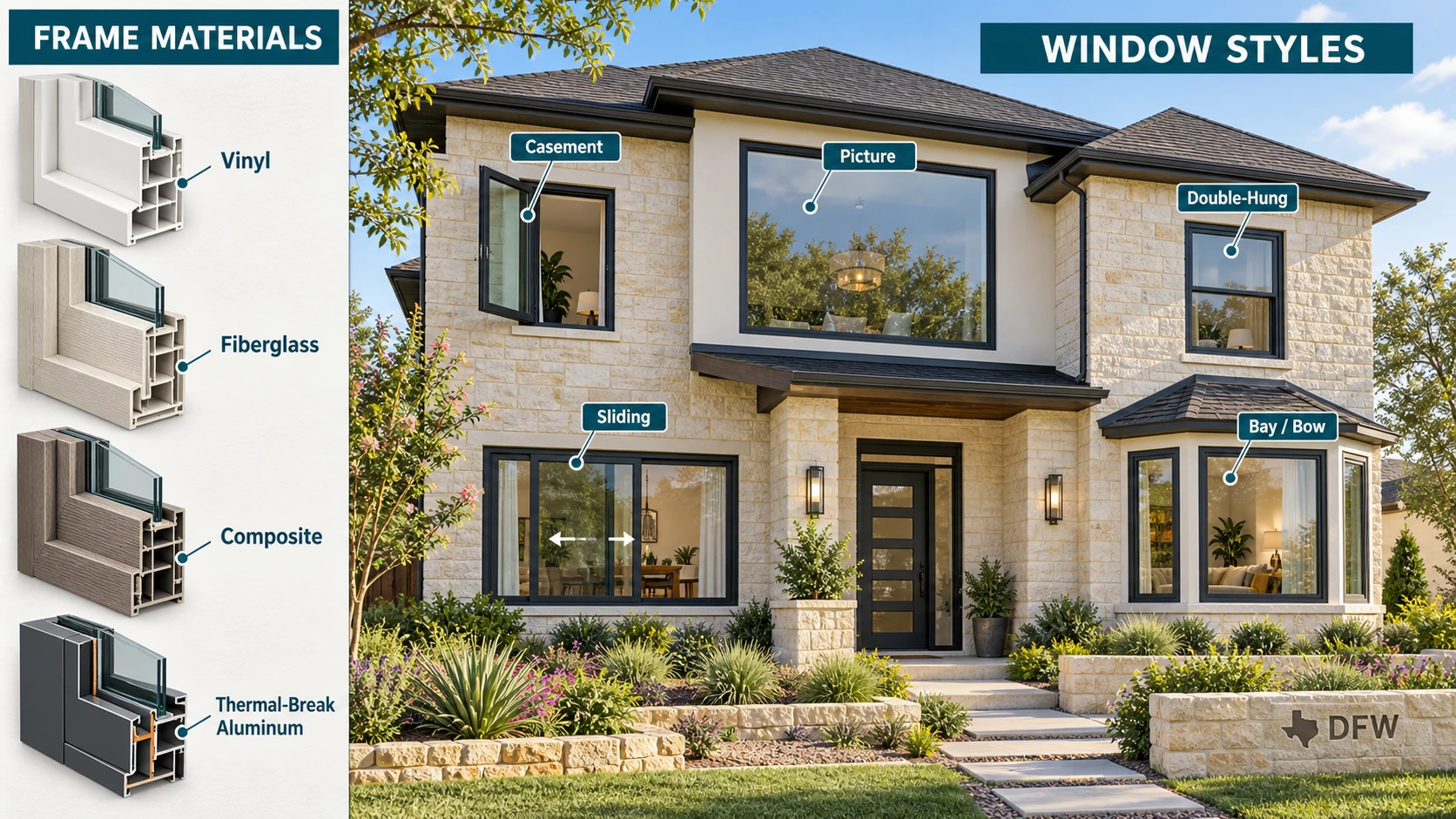
Frame material affects insulation, strength, warping, care, and cost. Vinyl frames can offer good insulation with little upkeep. Fiberglass stays stable as temperatures change, while composite frames can balance strength and insulation. Aluminum frames are durable, but extruded aluminum needs thermal breaks to limit heat moving through the metal.
Some insulated frames use foam, while others slow heat with several chambers inside the frame. Check the NFRC rating to see how the complete window performs. Our window frame material guide explains the differences between vinyl, fiberglass, composite, and aluminum.
Window styles affect how the sash closes and seals:
Casement
Casement windows close against a compression seal. If the hardware stays aligned, the sash can press firmly against that seal to help keep drafts out.
Picture
Picture windows do not open, so there are fewer moving joints where air can leak. They can suit rooms where you want a view without extra ventilation.
Double-hung
Double-hung windows let you adjust ventilation, but their sashes slide past weatherstripping. Keep the tracks and seals in good shape so they close properly.
Sliding
Sliding windows can suit the wide openings in many DFW homes. Clean tracks help the sash move freely and close against its seals.
Bay and bow
Bay and bow windows project outward to bring in light and a sense of extra space. Their head, seat, and joints need careful insulation to keep that area comfortable.
Solutions Contracting installs these window styles as well as custom architectural shapes. We can help match our windows and doors options to each room. That includes reviewing composite windows Dallas suppliers carry alongside other suitable frame choices.
07 Professional Window Installation
Even a good window can stick or leak if the opening needs work. A frame that sits out of square may stop the sash from closing evenly. Missing flashing can let water into the wall, while poor shimming and sealing can leave drafts around the frame.
Professional installation starts with measuring every opening, rather than assuming all the windows match. The crew should then work through these steps:
- Measure every opening: Each window is ordered to its own size rather than a rounded standard.
- Prepare the opening: Old units come out and the substrate gets checked for rot or damage.
- Complete the flashing: Layers are lapped so water drains outward instead of into the wall.
- Set the frame square: A square frame keeps the sash sealing evenly for years.
- Add shims and seal the gap: Correct shimming holds the frame true while insulation closes the air path.
- Replace the trim and finish: Interior and exterior trim goes back for a clean, weather-tight result.
Same window, 2 installs. The red flow is the difference on your bill.
A straightforward home window installation Dallas TX project may take 1 or 2 days, depending on the number of windows. Custom work or damaged openings can take longer. New construction openings expose the header, framing, sill pan, and flashing layers. If you are installing windows new construction Dallas additions need, the crew must use the method for that opening, rather than an insert replacement method.
5-year workmanship
Solutions Contracting provides a 5-year workmanship warranty on installation. It covers our fitting and sealing work under the written warranty terms.
Up to 20-year product
Select products include up to a 20-year manufacturer warranty. Check the terms for the exact product, since coverage differs by brand and product line.
Foundation movement and structural settling fall outside standard workmanship coverage. If your home has either issue, discuss it with us before signing so you know where that coverage ends.
08 2026 Window Replacement Costs and Financing
For early planning, $550 can serve as a starting allowance for a basic replacement window, rather than a confirmed market average. The size, glass, frame, trim, access, and opening repairs all affect the installed price. Large full-frame or premium units may cost more than $1,200.
| Project level | Typical specification | Planning range per installed window |
|---|---|---|
| Standard vinyl replacement | Double pane, solar Low-E, argon | $450 to $650 |
| Upgraded package | Fiberglass or composite, premium coating | $650 to $900 |
| Custom or architectural | Large spans, special shapes, specialty glass | $900 and up |
Use these ranges to plan, then request a price for your actual openings. If you compare energy efficient windows Dallas TX contractors install, each quote should include the product, labor, trim, repairs, and disposal.
Solutions Contracting offers flexible financing through lending partners. Example payments start near $18 monthly per $1,000 over 60 months, or $11 per $1,000 over 120 months. A 12-month same-as-cash option may charge no interest if you meet its payoff terms. Offers depend on approved credit and availability, so check the full agreement, including any deferred interest. Pre-qualification uses a soft credit pull.
09 Energy Savings, Comfort, and Window Film
Your energy bills depend on more than your windows. Shade, glass area, insulation, HVAC condition, thermostat settings, and power rates all affect the result. ENERGY STAR reports average savings of up to 13% on heating and cooling bills when certified products replace non-certified products nationwide. That is a broad estimate, not a promise for your home.
The U.S. Department of Energy reports average annual savings of $372 or more through its Weatherization Assistance Program. That program treats the home as a whole, so its savings should not serve as an estimate for windows alone.
You may notice a more comfortable room before you can compare the bills. Suitable glass and seals can reduce drafts, UV exposure, fading, and hot spots near the window. They may also help with noise reduction. Working, attractive windows can support property value, though no fixed increase applies to every home.
Window film may help with glare and solar heat gain if your existing window is still sound. It cannot fix failed seals, fogging between panes, warped frames, or sticking sashes. Before adding film, check the manufacturer warranty because some films can affect glass coverage.
Quick question: what bothers you most right now?
Choose the problem that affects your room most. The displayed percentages are preset examples, not results from a homeowner survey.
10 2026 Tax Credit and Weatherization Help
The credit closed for anything installed after 2025.
The federal Energy Efficient Home Improvement Credit covered 30% of eligible window costs, up to $600 a year, through December 31, 2025. The IRS confirms that later installations do not qualify. If your windows go in during 2026, leave this expired credit out of your budget.
Limited weatherization help still exists, but funding and eligibility can change:
- Oncor's low-income weatherization program uses approved third-party providers and requires Oncor electric delivery. Its 2026 funding is already exhausted, and Oncor says to check again in January 2027.
- Texas low-income weatherization may help through local providers. In 2026, DOE-funded help generally uses a 200% federal poverty guideline, while LIHEAP weatherization uses 150%.
- CEAP and LIHEAP support eligible households with energy needs. CEAP mainly covers utility and crisis help, while LIHEAP also funds Texas weatherization. Still, availability depends on the local provider.
- The City of Dallas Home Improvement and Preservation Program can support major home repairs for eligible owners, but HIPP applications are not currently being accepted as of September 2026.
If you need weatherization help, speak with the local provider before arranging work. They can check your income, housing situation, utility territory, and available funding. An energy audit may decide which improvements the program can cover.
11 Window Needs Across Dallas and Fort Worth
Dallas and Fort Worth use the same climate target, but the right window still depends on the house. Shade, age, storm exposure, and the condition of each opening can change what you need.
Dallas side
In older parts of Dallas, single-pane glass and conductive frames can leave rooms hard to cool. Homes in areas such as Lakewood, Oak Cliff, and Richardson may also have shifted openings. Check the frame fit as well as the glass before choosing replacements.
The urban heat island effect can keep built-up areas warmer after sunset. Our roofing contractors in Dallas can check whether the roof, attic, and windows are adding heat to the same rooms.
Fort Worth side
Tarrant County storms can cause hail damage to glass, screens, frames, and seals. If the roof has damage too, photograph each affected side of the home. Review the insurance claim before permanent repairs, while taking prompt steps to prevent further damage.
Our guide to hail damaged windows explains the signs to look for and the details worth recording.
A sheltered street and an exposed lot can place different demands on house windows Fort Worth contractors install. That matters in communities such as Keller, Southlake, and Benbrook. If you are comparing energy efficient windows Fort Worth options, our Fort Worth roofing contractors can review the windows alongside the rest of the exterior.
12 Windows, Roofing, and Attic Ventilation
Better windows cannot solve every cooling problem. Heat from the roof and attic can still reach the rooms below, especially if insulation or air sealing needs work. If the HVAC struggles upstairs, include the attic in the inspection.
Green is the air moving through your attic. Red is the heat it is meant to carry away.
Attic ventilation needs suitable intake and exhaust, often through ridge and soffit vents. Reflective roofing can also reduce roof heat in suitable assemblies. Our guide to roof ventilation in Texas homes explains how these parts work together.
Solutions Contracting can inspect your roof, attic, and windows in 1 visit. If hail damaged the same side of the home, keeping the findings together can make your insurance claim easier to follow.
13 How to Compare Window Companies in DFW
Are you searching for window replacement near you and getting quotes that look almost the same? These checks help you see which products and work each price includes:
- Confirm the ENERGY STAR climate zone, exact U-Factor, SHGC, and air leakage rating.
- Request the coating, pane count, gas fills, spacer, and frame details in writing.
- Check whether the price includes removal, disposal, flashing, insulation, trim, and finish work.
- Find out who performs the work and what the workmanship warranty covers.
- Confirm how the crew handles every opening that measures out of square.
- Read the manufacturer warranty and financing terms before paying a deposit.
If you search for a window manufacturer Dallas homeowners can buy from directly, compare the full installed cost. A lower unit price may not include measuring, fitting, or after-sales service. You should also know who handles a warranty claim if a problem appears.
Solutions Contracting brings 10+ years of exterior work across the Metroplex. We explain the label, glass specifications, scope, and warranty so you know what you are paying for before work starts.
Get the Right Windows for Texas Heat
When comparing new windows Dallas TX contractors offer, start with ratings that suit the local climate. Look for a U-Factor of 0.28 or lower and an SHGC of 0.23 or lower. Check air leakage, the glass package, the frame, and the installation too. If those details suit your room, the window can help control solar heat and keep you comfortable.
Ready to see which windows suit your home? We will measure each opening and explain the ratings before you decide.
14 Frequently Asked Questions
Start with a whole-window U-Factor of 0.28 or lower, SHGC of 0.23 or lower, and air leakage of 0.3 cfm/ft² or less. For energy efficient windows Dallas homes need, suitable double pane Low-E glass and argon can work well with an insulated frame. The installer must seal the opening properly too.
U-Factor measures how quickly heat moves through the whole window, while SHGC measures solar heat entering through it. Lower numbers can help in Texas heat. If the room gets strong sun, pay particular attention to SHGC as well as the frame and seals.
A 2026 installation does not qualify for the federal Energy Efficient Home Improvement Credit. It ended for property placed in service after December 31, 2025, even if the window meets the earlier product rules.
They may be worth comparing if a room has large temperature swings. Check the complete window's tested ratings and installed price first. For many DFW homes, a good double pane unit with suitable Low-E glass can offer a better balance of cost and comfort.
Use $450 to $650 per standard installed vinyl window as an early planning range. Fiberglass, composite, custom shapes, and specialty glass may cost more. Quotes for replacement windows Fort Worth projects also depend on any carpentry or structural repairs around the opening.
ENERGY STAR reports average savings of up to 13% on heating and cooling bills nationwide compared with non-certified products. Your result depends on the windows you replace, shade, insulation, HVAC, habits, and electricity prices. Replacing a few windows will not necessarily deliver that whole-home saving.
Look at how they work, not just their age. Drafts, failed seals, fogging between panes, sticking sashes, water entry, and storm damage all deserve an inspection. A roofer or window installer should check the surrounding opening as well as the unit.
It may help control glare and heat if the glass, frame, and seals remain sound. If the window leaks air or water, film will not repair it. Check the glass warranty before adding film, since some products can affect coverage.
Tight seals and multiple panes can help reduce sound. Laminated glass and different pane thicknesses may improve that result, depending on the assembly. Compare tested sound ratings if noise is a concern, because U-Factor and SHGC do not measure it.
Yes, Solutions Contracting installs replacements, custom shapes, and windows in new construction openings. We match the flashing and sealing method to the opening. We also check the South-Central ratings for the energy efficient windows Fort Worth and Dallas projects need.