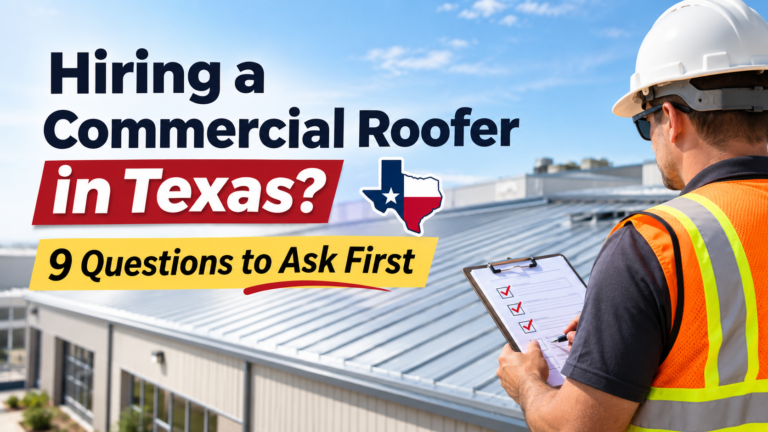
Is your building’s roof due for a repair, a coating or a replacement, and which contractor deserves the job? According to the Insurance Information Institute, Texas had 902 major hail events in 2025, more than any other state. That is why so many building owners across Dallas-Fort Worth are facing this roofing decision right now.
Hiring a commercial roofer in Texas takes more checking than in most states, and owners do most of it. Texas has no state roofing license, and most private employers can choose whether to carry workers’ compensation insurance. The nine questions below help building owners, property managers and facility managers compare contractors on proof, not promises.
Ask these questions before any contract is signed, because answers are easier to compare before money changes hands. At Solutions Contracting, we hear them from DFW owners all the time, and a good roofer should welcome every one.
Why Texas Building Owners Need to Ask More Questions
Many owners assume every roofer must hold a state license, but Texas does not license roofing contractors statewide. The Roofing Contractors Association of Texas runs a voluntary licensing program, and cities set their own registration and permit rules. Because of that, the word “licensed” on a roofer’s truck can mean different things from one company to the next.
Workers’ comp is the second surprise for many owners, and it affects every crew that climbs onto a commercial roof. The Texas Department of Insurance explains that most private employers in Texas can choose whether to provide workers’ compensation coverage. So it is worth knowing exactly how a roofing crew is covered before anyone steps onto your building.
Commercial roofs also carry bigger stakes than homes, because tenants, inventory and rooftop HVAC units depend on a dry building. Here are the nine questions to ask, in the order most building owners and property managers find useful.
1. What Licenses, Registrations and Certifications Do You Hold?
Since there is no state license, ask for the credentials that do exist and check each one yourself before signing. A careful commercial roofing contractor will share these details quickly, without needing to be asked a second time. At Solutions Contracting, more than 10 years of DFW roofing work and a BBB A+ rating stand behind our answers.
- RCAT License: Ask whether the company holds the RCAT license for commercial work, since this credential is voluntary in Texas. Applicants must pass a commercial roofing exam and carry at least $500,000 in general liability insurance to qualify.
- City Registration and Permits: Find out which DFW cities the roofer is registered in, and who will pull the permit for your building. Rules differ from city to city, so the contractor, not your property manager, should handle the permit application.
- Manufacturer Certifications: Membrane and coating manufacturers approve installers for their roof systems, so ask which ones have approved this company. Many long-term manufacturer warranties are only available when an approved installer completes the roofing work on your building.
2. Can You Send Certificates for Liability and Workers’ Comp Insurance?
Some roofers lower their bids by carrying too little insurance, so ask for proof of coverage before comparing prices. Request a certificate of insurance sent directly from the roofer’s insurance agent, not a copy from the sales rep.
Read the policy dates, the coverage limits and whether your company can be named as an additional insured. If a policy ends before your project does, ask for proof of the renewal before the crew starts work.
For a workers’ comp nonsubscriber, ask how injured workers are covered instead, and get that answer in writing. If the company carries workers’ comp, request its Experience Modification Rate (EMR), which reflects its past injury claims. An EMR below 1.0 is generally a good sign, because it points to a better safety record than average.
3. Which Commercial Roof Systems Do You Install and Repair?
Flat and low-slope commercial roofs come in several systems, and each one needs different tools, training and repair methods. Ask which of these systems the contractor works on every month, not just once or twice a year.
- TPO and PVC Membranes: These single-ply roofs have heat-welded seams and cover many warehouses, retail centers and office buildings across North Texas.
- EPDM and Modified Bitumen: Older strip centers and offices still use these systems, and repairs need materials that bond to the existing membrane.
- Metal R-Panel and Standing Seam: Industrial buildings often use metal roofs, which need careful work on fasteners, seams and rust before any coating goes on.
- Silicone and Acrylic Coatings: These liquid systems restore a sound existing roof without a full tear-off, as long as the roof passes testing.
Also ask whether the company self-performs the work with its own crews or hands the job to subcontractors. That answer tells you who will really be on your roof and who answers for the quality of the work.
Solutions Contracting installs and repairs flat roofing systems such as TPO, as well as metal R-panel roofs. That range lets our team explain the real trade-offs of each roof system for your building and budget.
4. Is My Roof a Candidate for Coating Restoration or Replacement?
This question can save the most money, and an honest answer starts with testing the roof, not guessing. A roof coating can extend the life of a sound roof, but it cannot fix wet insulation underneath. If wet insulation stays under a new coating, the moisture keeps damaging the deck and the coating can blister.
Ask the roofer how they will check for moisture, such as with an infrared scan or core cuts. Also ask how much wet area would rule out a coating, so the decision rests on a clear limit. Solutions Contracting uses infrared scans to find hidden moisture, which helps show whether a roof is suitable for coating.
Under the 2021 International Building Code, a new roof covering cannot go over an existing roof that is water soaked. The same rule applies when a roof already has two or more coverings, so a full tear-off may be required. When a roof is too wet to coat, we tell the owner plainly and explain the replacement options instead.
A good contractor will also explain silicone versus acrylic, because each coating suits a different kind of roof. Silicone handles ponding water better, while acrylic coatings are usually chosen for commercial roofs that drain well. Our team applies silicone and acrylic roof coatings only after a full assessment of the roof’s condition.
| What We Found, How We Fixed It: [Solutions Contracting team: add a real before-and-after photo pair from a recent DFW commercial coating or repair job here, with one line on what the inspection found and one line on how the crew fixed it.] |
5. What Exactly Will Your Written Proposal Include?
Two bids can look far apart only because they cover different work, so compare the proposals line by line. If one bid is far lower than the others, the missing items usually show up in the scope or exclusions.
- Scope of Work: The proposal should list the roof areas, the system, and the membrane type or coating thickness for each area. It should also explain how the crew will handle drains, curbs, flashing and edge metal on your roof.
- Unit Prices: Ask for a set price per square foot for replacing wet insulation or damaged deck found during tear-off. Those unit prices stop hidden problems from turning into open-ended charges once the old roof comes off.
- Change Orders: The contract should explain how extra work gets approved in writing before the crew starts any of it. It should also name the person on your side who has the authority to sign each change order.
- Payment Schedule: Deposits and progress payments should be tied to finished stages of work, not to dates on a calendar. If a roofer asks for most of the money upfront before any material arrives, treat that as a red flag.
Insurance jobs carry one more Texas rule that every commercial building owner should check before signing a roofing contract. For contracts of $1,000 or more paid partly by insurance, Business & Commerce Code §27.02 requires a bold deductible notice. That notice tells the owner, in writing, that Texas law requires the insured to pay the deductible.
A missing notice on an insurance job is a warning sign about how the roofer runs the whole project.
6. How Will You Protect Tenants, Operations and Safety?
Your building keeps working during a roof project, so the plan for tenants, noise and access matters a lot. If tenants only hear about the project the week it starts, complaints usually follow and trust drops quickly. Ask who prepares the tenant notices, when they go out and what they say about noise and odors.
- Work Hours: Ask about off-hours or phased work in occupied buildings, especially medical offices, restaurants and multi-family properties with residents at home.
- Rooftop Equipment: Your roofer should explain how HVAC units, vents and skylights will be protected while the crew works around them. Also confirm who coordinates with your mechanical contractor if any rooftop units must be lifted or disconnected during the work.
- Fall Protection: OSHA requires fall protection for workers on low-slope roofs 6 ft or more above a lower level. Ask whether the crew uses guardrails, safety nets or fall arrest systems, or warning lines paired with another system.
- Staging and Cleanup: Get a staging plan that shows where cranes, dumpsters and materials will go, and when deliveries will arrive. Fire lanes, parking and entrances should stay open, with a full cleanup at the end of each workday.
Solutions Contracting schedules commercial roof repairs with facility managers, including evening and weekend work when a business cannot pause.
7. What Warranty Will I Get, and What Keeps It Valid?
A commercial roof usually comes with two separate warranties, and owners need to know who stands behind each one. The manufacturer warranty covers the materials or, at higher levels, the whole roof system for a set term. The contractor’s workmanship warranty is separate, and it covers how the crew installed the roof on your building.
If other trades will work on the roof later, ask what could void either warranty during that work. Common examples include unapproved rooftop work, missing maintenance records and cuts in the membrane from other contractors. Since most manufacturer warranties expect regular inspections, ask whether the roofer offers preventive maintenance with written reports.
8. How Do You Handle Storm Damage and Insurance Claims in Texas?
After hail or high winds, a roofer’s role in your insurance claim is useful but limited by Texas law. Under Texas Insurance Code §4102.163, contractors cannot act as public adjusters where they provide or may provide services. The same section also bars advertising to adjust those claims, even when the contractor holds a power of attorney.
A trustworthy contractor documents the damage with dated photos and measurements, then meets your adjuster on the roof. That contractor answers technical questions, while you or a licensed public adjuster handle the claim negotiation itself.
Our managing partner Tony McCarty spent 17 years as a licensed insurance adjuster before moving into storm restoration. That background helps our team prepare the kind of roof documentation that adjusters expect to see on a claim.
If any roofer offers to cover or absorb your deductible, walk away from that offer and that company. Texas Insurance Code §707.002 requires the insured to pay any deductible that applies to a first-party property claim. For active leaks, Solutions Contracting offers 24/7 emergency storm response with temporary protection until the permanent repair is done.
9. What Will I Receive When the Job Is Finished?
The paperwork at closeout protects the owner for years, so ask about every document before any work starts.
- Lien Waivers: Texas lien waivers are only enforceable on the statutory forms in Property Code §53.284, so check every form. Ask for conditional waivers with each progress payment, then unconditional waivers once the final payment has cleared.
- Retainage: Property Code §53.101 requires owners to hold back 10% of the contract price until 30 days after completion.
- Closeout File: Expect before-and-after photos, warranty documents, product data sheets and a roof plan that marks every repair location.
- Maintenance Schedule: Ask for a written plan of inspections and drain cleaning that keeps the warranty in good standing.
Solutions Contracting documents commercial work with before-and-after photos, so owners see exactly what was found and fixed.
Choose a Commercial Roofing Contractor With Answers in Writing
Hiring a commercial roofer in Texas goes smoothly when every answer comes back in writing, from insurance to lien waivers. A contractor who explains the testing, scope and warranty clearly will usually protect your tenants and budget too.
Hail season in North Texas returns every spring, and roofers’ schedules fill quickly after the first big storm. An inspection this fall or winter lets you compare bids calmly, instead of choosing a roofer during a leak.
Solutions Contracting is ready to answer all nine questions for your property, in writing and before you sign. Book a commercial roof inspection and coating assessment, and our team will inspect every section of your roof. We will show you what we find, what it means and the options that fit your budget.
Frequently Asked Questions
1. Do Commercial Roofers Need a License in Texas?
Texas has no state license for roofing contractors, so credentials come from the voluntary RCAT program and city registration. Ask for the RCAT license number, city registrations and insurance certificates, and verify each one before signing.
2. How Many Bids Should I Get for a Commercial Roof?
Most owners compare three written bids, which is usually enough to spot a missing scope item or unrealistic price. If the bids use different systems, ask every roofer to price the same system, scope and unit prices.
3. Can a Roofer Negotiate My Insurance Claim in Texas?
A contractor that works or may work on your property cannot act as a public adjuster for it. The roofer can document damage and meet the adjuster, while the owner or a licensed public adjuster handles negotiation.
4. How Long Does a Commercial Roof Coating Last?
Most commercial roof coatings last about 10 to 20 years, depending on the product, the thickness and the roof’s condition. Regular inspections and small touch-ups help a coating reach the longer end of that 10 to 20 year range.
5. How Often Should a Commercial Roof Be Inspected?
Most commercial roofs should be inspected at least twice a year, in spring and fall, and after major storms. If you keep written inspection reports, they help keep manufacturer warranties valid and support future insurance claims.